

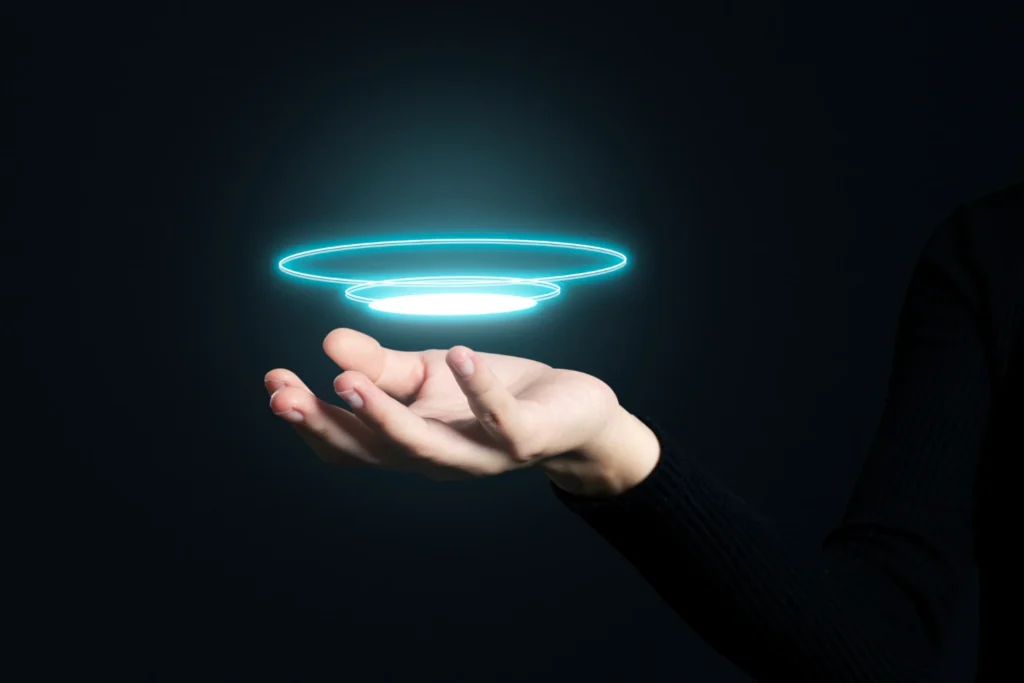
An image that doesn't exist—but you can see it? Is that even possible? It looks like magic, but it's based on physics, the psychology of vision, and a clever optical trick. Holographic 3D projections aren’t an illusion—they’re the result of technology that plays on how your eye processes images. Holographic technology works based on the phenomenon of persistence of vision (POV). This is the mechanism by which the brain „stitches together” rapidly successive images into a smooth sequence.
However, these are not the classic „Star Wars”-style holograms that require laser light interference. In modern devices, such as LEDHOLO displays, the three-dimensional image is created by the rapid rotation of arms equipped with LEDs, which play back an encoded animation at a rate of over 30 frames per second. That's enough to trick the eye and create the impression of a 3D image floating in the air.
From the Rotor to a Sense of Spatiality
To put it simply: you have a device with several arms, each equipped with LEDs. During operation, the arms spin at high speed, and each LED lights up at a precisely determined moment. The LEDs do not stay on continuously—their operation is precisely synchronized with the rotor’s movement. As a result, the image they create forms in space like a hologram. It is this process that determines how a 3D hologram is created in next-generation devices.
The software sends signals to the LEDs, which respond instantly and display the programmed animation frame by frame. The background is black (because LEDs don't emit black light), so all you'll see is a bright, floating image—with no visible display surface. This is the entire process that explains how holographic technology works without the need for physical screens or special glasses.
Holograms and the Human Brain—It Works Because That's How We See Things
The brain does not analyze each frame individually. It combines them into a single sequence and interprets them as motion, depth, and three-dimensionality. This is the same principle that was at work in 19th-century optical toys, such as the phenakistoscope. But today we’re talking about an advanced version—the LEDs flash with millisecond precision, and the effect is incomparably more realistic. Holographic technology, therefore, draws not only on physics but also on the psychology of perception.
What you see is the result of the interaction between light, speed, and your nervous system. LEDHOLO technology was designed to take full advantage of this mechanism—the rotor, SMD LEDs, precise synchronization, and optimized software combine to create an image that „hovers” in space.
Where does this work? Not just in advertising
How is it created? 3D hologram In practice? You upload an animation (usually in .mp4 format), manage it through an app (such as LEDHOLO Smart), the device receives the data, and begins displaying the programmed content. You can use a single projector or connect several of them in a so-called MatrixX setup—in which case the hologram achieves truly large dimensions and high resolution. This technology is used, among other things, in product promotions, museums, education, events, and even as interactive cultural media.
Because the process relies on a rotating rotor, the entire structure can be lightweight, easy to install, and does not require screens or a dark room. Content can be managed remotely, updated in real time, scheduled for display, and adjusted for brightness.
Holograms evoke emotions. And they drive sales.
It's not just about technology. Research conducted by SWPS using LEDHOLO projectors shows that Holographic images have a much stronger impact on emotions and purchase intent than traditional 2D advertising. People are more engaged, willing to pay more, and are better at remembering the brand and the product. A hologram doesn’t just show—it makes an impression. It works because a 3D image in space interacts with our perception of reality. Holographic technology affects not only how something looks—but also how it feels. It’s not just a visual medium—it’s a tool for influence. In that sense, a hologram is a weapon in the hands of marketers, salespeople, and educators.
What's next?
This is just the beginning. The better the LEDs, the faster the processors, and the more efficient the synchronization algorithms—the better the result. We are moving toward interactive holograms that respond to movement, sound, and voice. There won't be any need for screens. You walk into the store, and the product „appears on its own.”. Education, art, entertainment—anywhere you can show something, you can show it better with holographic technology.