

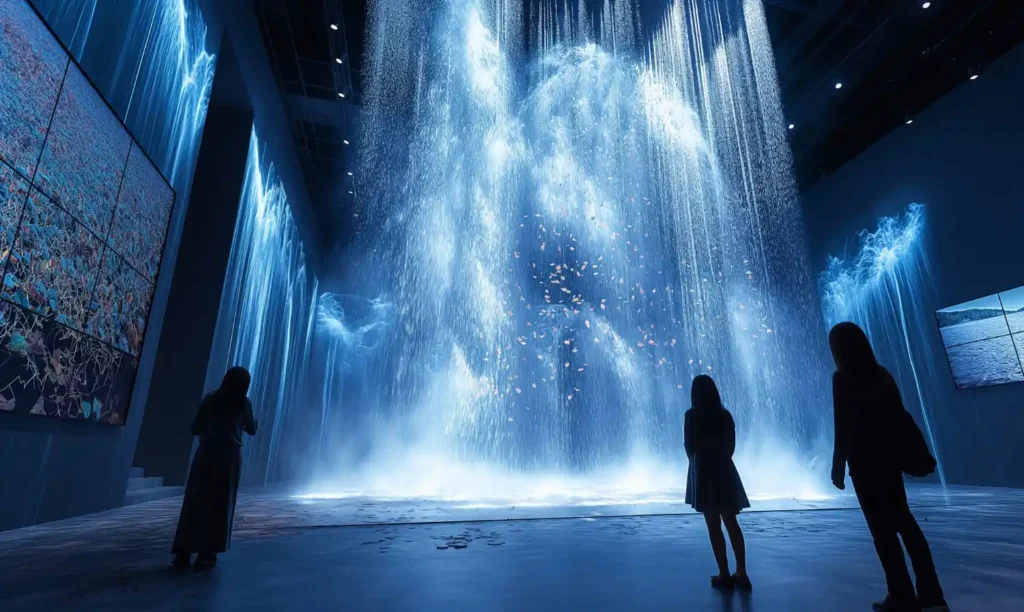
At trade shows, everyone is clamoring for attention. Colors, banners, hostesses, LED screens. And everything starts to look the same. The problem isn’t that companies lack ideas; it’s that the audience has already seen it all. That is precisely why something that works differently is emerging—the hologram. Not just as a gimmick, but as a real tool for attracting attention and making initial contact. Holograms for events are becoming an increasingly popular choice. Below, we explain why!
Key Information:
- The hologram immediately catches the eye and draws people to the booth,
- increases the time spent interacting with the brand,
- allows the product to be displayed „in mid-air,” without being physically displayed,
- operates at both trade shows and conferences,
- It influences emotions and how well the message is remembered.
Does a hologram at a trade show booth really attract more people?
Yes—and that's not just a marketing gimmick, but a psychological effect. Studies show that holographic advertising evokes stronger emotions and increases purchase intent compared to traditional 2D formats.
At the trade show, it looks very straightforward. People walk down the aisle, scan the area, and stop only at something that catches their attention. A hologram does exactly that—it snaps you out of autopilot. An example? A booth showcasing a tech product. Instead of a roll-up banner—a floating model of the device spinning in the air. People approach. They stop. A conversation begins.
How can you use a hologram at an event so that it’s not just a „wow factor”?
The „wow” factor lasts only a few seconds. After that, it's the meaning that counts. That is why a hologram should be an integral part of the communication strategy, not just an add-on.
The following work best:
- 3D product presentations (e.g., exploded views),
- animations demonstrating how the service works,
- dynamic storytelling (e.g., a brand story in 20 seconds).
Hologram for an event It works best when it shows something that cannot be easily shown in person. So you're not just copying a directory. You're creating an experience.
How much space does a hologram require, and does it make the booth more complicated?
This is where many people are mistaken. They think, „It must be complicated.” It doesn’t have to be. Modern solutions are designed specifically for events: they feature lightweight structures, can be assembled quickly, and don’t require a lot of space. A hologram for a trade show booth can serve as the centerpiece of the booth or as a complementary element. And, importantly, it doesn't take up space. It „creates” it.
Do holograms work differently at conferences than they do at trade shows?
Kind of. It’s a different context, with different dynamics. At conferences, the audience isn’t „just passing by”—they’re already seated and listening. It’s not about grabbing their attention, but about holding it and deepening it. That is why a hologram at a conference serves a different purpose than at a trade show.
Holograms at conferences:
- enhances presentations and gives them a „live” feel,
- helps visualize data, processes, and structures,
- It helps build an image of an expert who uses modern tools.
Holograms at conferences serve more as a communication tool than as a way to attract traffic. They aren't competing with other booths—they're competing with distractions. Imagine a presentation of a medical product. Instead of a static slide—a 3D model floating in space that you can rotate to reveal its structure layer by layer. Complicated things suddenly become intuitive.
Or a tech presentation where, instead of charts, there’s a dynamic visualization of data projected into the air. It doesn’t just look better. It’s easier to understand and remember. And that’s exactly the point. It’s not about the effect. It’s about the clarity of the message.
Check also: Displaying Museum Exhibits Using 3D Holograms
What makes a hologram at an event effective, rather than just looking like a gimmick?
Three things. And each one is more important than it seems.
First—context. The hologram must be consistent with the brand, its aesthetic, and its communication style. If a company projects a premium image but throws in a random animation „just because it’s flashy,” the whole thing falls apart. The audience can tell right away.
Second—content. Technology alone doesn't get the job done. 3D Animation It has to explain, demonstrate, or simplify something. If it doesn't add value, it becomes nothing more than a flashy accessory that you'll quickly grow tired of.
Third—timing. A hologram shouldn't work all the time and everywhere. It works best when it appears at a specific moment—at the beginning, during a presentation, or as the climax of the experience. That’s when it really makes an impact.
The biggest mistake? A 3D screen thrown in at random, without any concept behind it. The effect is the opposite—instead of drawing attention, it looks like a superfluous gimmick that’s just „there.”.
Pro tip
A simple approach works best: pause → spark interest → explain → remember
The hologram takes the first step. The rest is up to your strategy.
FAQ
Will a hologram work well at a small booth?
Yes, especially then—because it stands out even more.
Is a special space needed?
No, most solutions work under standard trade show conditions.
Is the hologram difficult to use?
No—content management is simple and is often done directly within the app.
Is this solution only for large companies?
No—more and more medium-sized companies are using them to their advantage.