

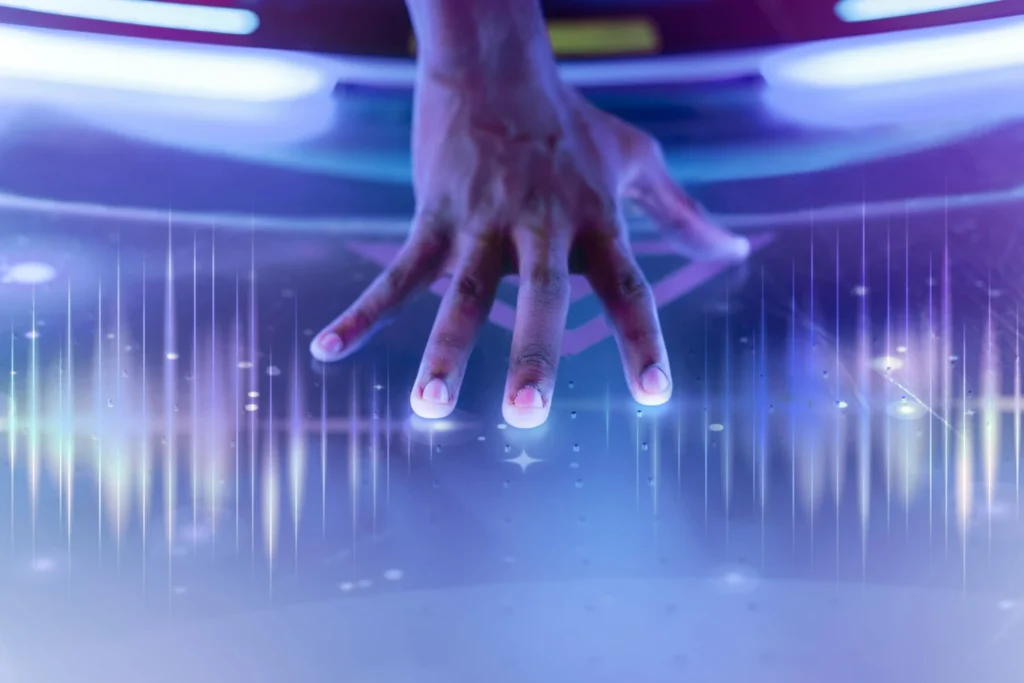
What is a hologram?

What is a hologram? It is a three-dimensional image created using light that, unlike ordinary photographs, captures both the intensity and the phase of light, providing depth and perspective. Holograms, which utilize the phenomena of interference and diffraction, are used in security, medicine, and entertainment, and their versatility makes them an effective safeguard against counterfeiting. This technology, based on the superposition of laser beams, plays a key role in accurately reproducing details and viewing angles, ensuring a realistic three-dimensional effect.

What exactly is a hologram?

A hologram is a three-dimensional image created using light. Unlike traditional photographs, which capture only the intensity of light, holography also captures its phase. This makes it possible to realistically reproduce an object in space, preserving depth and perspective.

How is a hologram created?

The process of creating a hologram begins with a laser whose beam is split into two parts: a reference beam and an object beam. The reference beam strikes the photosensitive material directly, while the object beam illuminates the object, and the light reflected from it also reaches the same medium. When the two beams meet, a characteristic interference pattern is formed—and it is this pattern that is recorded on film or another medium. Interference—that is, the overlapping of light waves—creates a unique pattern that contains complete information about the light reflected from an object. Check also: Holographic projectors

How can you see a hologram?

To produce a three-dimensional image, the finished hologram must be illuminated again with coherent light, most often from a laser. This light passes through the recorded pattern and undergoes diffraction—a phenomenon in which waves are diffracted by the hologram's structure. As a result, a light wave is produced that is identical to the one that was previously reflected off the actual object. It is this that creates the impression of a three-dimensional image floating in the air.

How is a hologram different from a photograph?

Unlike a photograph, which presents a flat image, a hologram offers depth and the ability to view an object from different perspectives. What's more, every part of the hologram contains information about the entire object. OThis means that even after the hologram is cut into smaller pieces, each piece still displays the entire image—albeit with less detail. Check also: How does a 3D hologram work?

Where is holography used?

Holography is used in many areas of life. It is used, among other things, to secure documents, in the arts, in science, and in modern technologies. It’s a combination of precision and striking aesthetics that can truly surprise you. For example, holograms are used in credit cards and banknotes as a security feature to prevent counterfeiting. In medicine, holography makes it possible to create three-dimensional models of organs, which facilitates surgical planning. In the entertainment industry, holograms come to life on stage, showcasing virtual artists.

What physical phenomena are used in holography?

Holography uses the phenomena of light interference and diffraction to create three-dimensional images. A key element of this process is the superposition of two laser beams: the beam reflected from the object (known as the object beam) and the reference beam. The interference of these beams creates a complex pattern that is recorded on photosensitive material, forming a hologram. This formula contains information about both the amplitude and phase of the light reflected from the object, which makes it possible to reconstruct the full spatial information. To view a three-dimensional image, the hologram is illuminated with an appropriate light source, most often a laser with the same wavelength as that used to create it. The incident light is diffracted by the hologram's structure, recreating a three-dimensional light wave identical to the one that was reflected from the original object. As a result, the observer sees a three-dimensional image that appears to float in space. Diffraction gratings, which are a component of the hologram's structure, play a crucial role in accurately reproducing details and viewing angles, ensuring a realistic three-dimensional effect.

How can you tell if a hologram is real, and how can you distinguish it from a fake?

How can you tell if a hologram is genuine and avoid being fooled by a fake? Contrary to what you might think, it’s not complicated—you just need to know what to look for. An original hologram is distinguished by its three-dimensional effect and distinct sense of depth, which changes depending on the viewing angle. It is precisely this dynamic change that makes the image seem to move along with the viewer. Look at the hologram from different angles—a genuine hologram will display different perspectives and depth, which cannot be achieved with a fake. On the other hand, imitations such as 3D prints, while they may resemble holograms, do not convey the same impression. They do not respond to light in such a complex way; they lack both depth and that characteristic shimmer. They are often simply flat images with a visual effect intended to mimic three-dimensionality. A hologram is, first and foremost, an optical effect based on the interplay of light. The original shimmers with a variety of colors, refracts light, and often sparkles. When viewed through a magnifying glass, you can see fine details that confirm its authenticity and attest to the advanced technology used in its creation. Pay attention to the precision of the workmanship—authentic holograms are characterized by high resolution and the absence of imperfections. It’s also worth remembering that holograms used as security features are single-use—any attempt to peel them off usually results in them being damaged. This is an effective way to prevent attempts at reuse. Check whether the hologram has self-destructive features that prevent it from being transferred to another object. Some, especially those made using thick-film technology, contain a special diffraction grating. Thanks to this, they produce a three-dimensional image that is visible even in ordinary light, without the need for a laser. This technology makes it possible to achieve a more realistic and long-lasting holographic effect. In short, a true hologram is not just an image, but a complex light effect that cannot be easily faked. It only takes a little attention to tell the original from the imitation. Keep in mind that you can verify the authenticity of a hologram by observing how it appears under different lighting conditions and from different angles. Check also: How much do holograms cost?

What does the future hold for holography, and what innovations are in the works?

The future of holography is evolving rapidly thanks to advances in digital technology. Three-dimensional holograms that can be viewed without special glasses are becoming increasingly common. Instead of static images, we see moving projections that can be viewed from different angles, creating a sense of depth and presence. These innovations also include interactive holograms that respond to touch and gestures, opening up new possibilities for human-computer interaction. Holograms are evolving from a technological curiosity to a potential part of our everyday lives, thanks to their integration with virtual and augmented reality. They may soon find applications in education (e.g., interactive anatomical models), medicine (holographic visualizations of patient data), entertainment (concerts featuring holograms of artists), and communication (holographic teleconferences). Advances in holography are changing the way we experience the digital world. Advances in display technologies, such as volumetric displays and light interference techniques, are leading to the creation of more realistic and immersive holograms. In the future, we can expect holograms with higher resolution, larger scale, and real-time interactivity, which will revolutionize many aspects of our lives.

Will holograms become commonplace in everyday life, and how is digital hologram technology evolving?

What exactly is a hologram? It’s a modern technology that’s likely to become part of our everyday lives soon. A hologram is a three-dimensional image created through the phenomena of interference and diffraction of light waves. Unlike traditional photographs, a hologram records not only the intensity of light but also its phase, which allows for the reconstruction of complete information about the object. The applications of holograms are very broad and are constantly evolving. Today, we find them in the security features of banknotes and credit cards, in smartphone screens (though not yet fully three-dimensional), in GPS systems, in advertising campaigns, and in the world of entertainment, where they create spectacular special effects. Digital holograms are advancing at a rapid pace, and their potential is enormous. Their main goal is to create three-dimensional, extremely realistic images that you can not only view but also interact with. In the future, we can expect to see holograms used in education (e.g., interactive anatomical models), medicine (3D visualizations of organs), design (product prototyping), and telecommunications (holographic videoconferencing). The development of digital hologram technology depends on advances in lasers, displays, and image-processing software.

FAQ

What is a hologram, and how is it different from a photograph?

A hologram is a three-dimensional image created using light, which captures both the intensity and the phase of the light. Unlike photographs, a hologram offers depth and the ability to view an object from different perspectives, creating a sense of spatiality.

How is a hologram created?

A hologram is created by splitting a laser beam into a reference beam and an object beam. When the two beams meet on a photosensitive material, they create an interference pattern that records information about the object.

What characteristics should a security hologram have?

A security hologram should feature microtext, a kinematic effect, and changing colors to make it difficult to counterfeit. Additionally, it should be made of materials that self-destruct when an attempt is made to remove it.

Where can I use holograms? What kind of technology is this?

Holograms are used in document and product security, medicine (3D visualizations), entertainment (virtual artists), and art (interactive installations). You can find them on credit cards, banknotes, and admission tickets.

Will holograms become commonplace in everyday life?

Advances in digital hologram technology suggest that this is the case. What will holograms of the future look like? Interactive anatomical models in education, 3D visualizations of organs in medicine, and even holographic videoconferences may become the norm.
Shopping Cart
Scroll to Top