

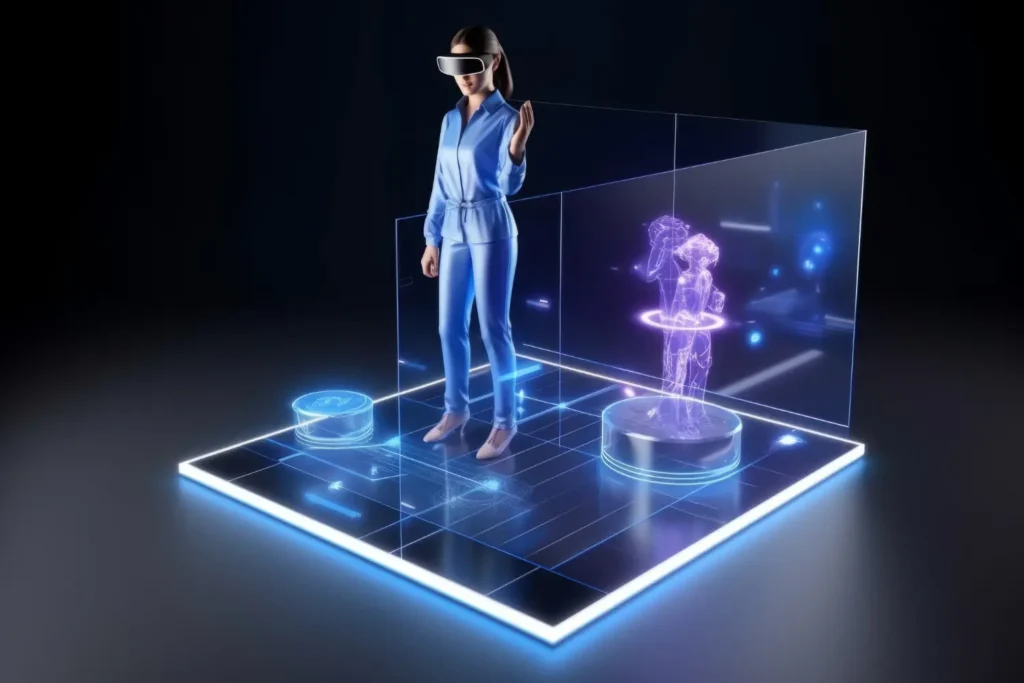
Advertising is no longer one-sided. This is no longer a time when the brand speaks and the audience just watches. The customer doesn’t want to just watch. They want to participate. They want to explore, interact, choose, and respond. The more they can do on their own, the greater their engagement and the better their understanding of the product. That’s why everything is naturally shifting toward interaction. And here comes the next step—an interactive hologram. Not as a visual effect, but as a tool that changes the way people interact with the brand. It doesn’t just show; it reacts. And that’s when the real experience begins.
Key Information:
- interactive hologram engages the user in real time,
- makes the experience more memorable,
- allows you to control content (gestures, movement, touch),
- builds a competitive advantage,
- combines technology with emotion.
What exactly is an interactive hologram?
This isn't just a simple animation that plays on a loop and looks impressive for a few seconds. It operates on an entirely different logic. It's a system that responds to the user—more specifically, to the user's movement, choice, or specific action. An interactive hologram allows the user to influence what they see—in real time. There is no single scenario. It is an experience that changes depending on what the viewer does.
It could be:
- a change to the product or variant,
- rotating the model and viewing it from every angle,
- selecting options that affect the subsequent presentation.
In practice, what happens is that the recipient is no longer just a spectator. They begin to „interact with” the message. And that’s where the biggest difference lies. An interactive hologram is no longer just an advertisement you watch. It's an experience you dive into—and one that stays with you for much longer.
Check also: Holograms for Premium Brands
How does an interactive hologram change customer behavior?
In short: it engages. But not superficially—it actually changes the way the audience processes the message. When a user does something rather than just watching, their attention works differently. They have to make a decision, take action, and see the result. This activates both memory and emotions at the same time.
An interactive hologram extends the time spent engaging with the brand and increases engagement. And that translates into something more important—a better understanding of the product. Instead of a 3-second glance, you get 30 seconds of interaction. The user rotates the model, explores the options, and „tests” the product at their own pace. And suddenly, a message that would normally be just information becomes an experience. And experiences, unlike ads, stick in your mind.
Where do interactive holographic displays work best?
Where a purchasing decision requires understanding, not just a first impression.
There are products that can’t be sold with just a single image. You have to show them in action, break them down into parts, and explain them step by step. And it’s in situations like these that interaction makes the biggest difference. The best uses for interactive holograms are in spaces where a customer wants or needs to check something before making a decision:
- retail, where they select a specific product variant,
- showrooms, where they can explore the product lineup and compare options,
- fair, where what counts is a quick but thorough understanding,
- education, where a visual representation takes the place of a complicated explanation.
Interactive holographic displays allow customers to „test” a product without physically touching it. They can see how it works, what it looks like in different configurations, and how it responds. And suddenly, one of the biggest barriers—uncertainty—disappears. And that’s the moment when technology stops being just an add-on and starts to have a real impact on the decision.
Is the interactivity of holograms just a gimmick or does it offer real value?
Real. And the kind that can be noticed not only „at a glance,” but also in the viewer’s behavior.
Interaction changes the way a message is perceived. You go from passive viewing to active participation. And that automatically increases your level of attention and retention. Why does this work?
- greater engagement—the user is doing something, so they stay focused longer,
- a better understanding of the product—he checks for himself how it works,
- stronger emotions—because the experience is „his,” not something imposed on him.
Interactivity isn't just an extra feature. It's the way customers build a relationship with the product. And emotions? They bring the whole process to a close. And emotions = decisions.
Pro tip
Don't go overboard with the options. 2–3 interactions work better than 10.
FAQ
Is an interactive hologram difficult to implement?
No—modern systems are getting simpler and simpler.
Does it work without touching it?
Yes—it can respond to movement and gestures.
Is this the future of advertising?
Rather, the present, which is just getting started.